Insider's Den
See it Live →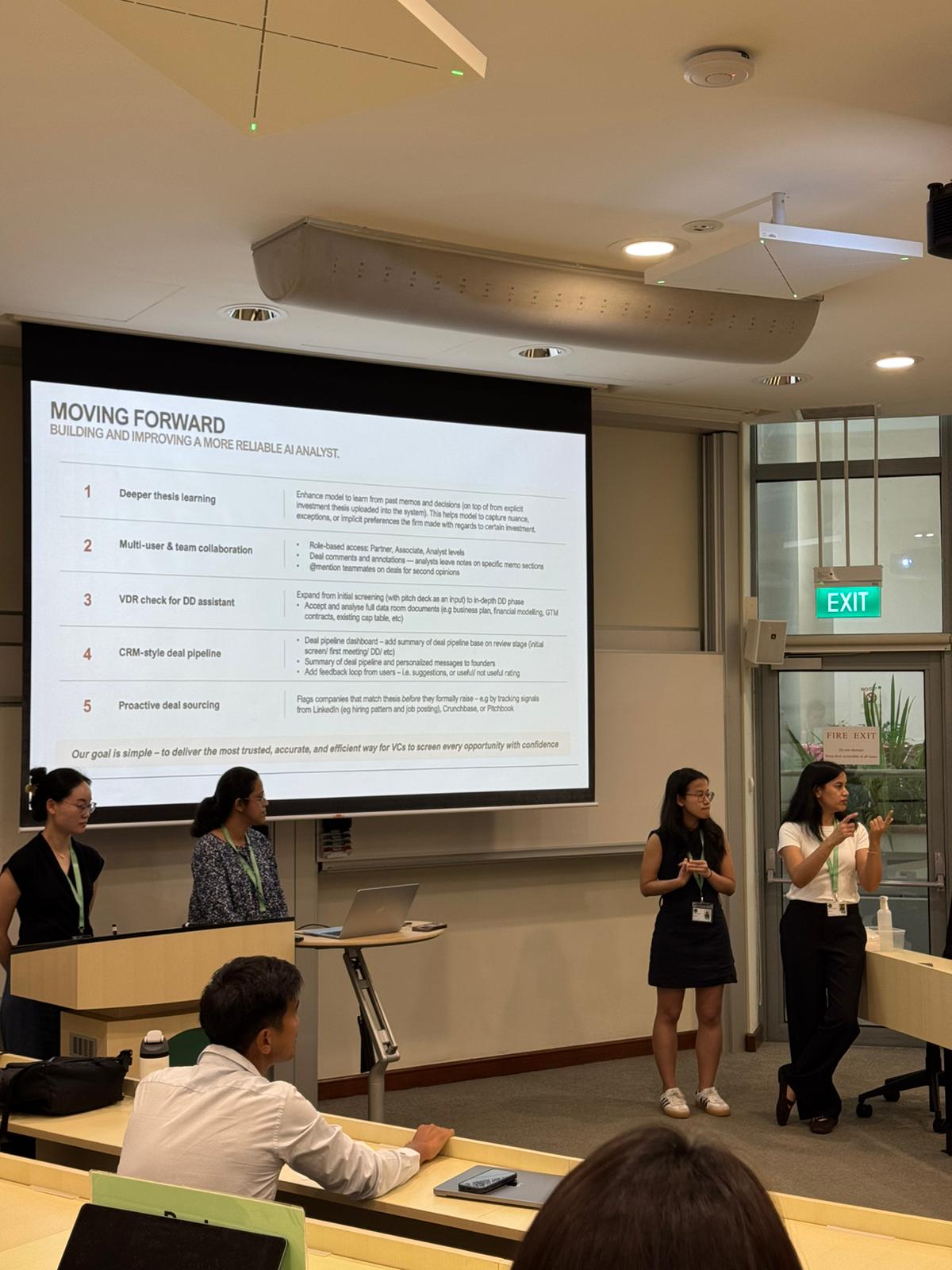

As part of the Gen AI Products & Businesses course, we built a tool that helps VCs stop drowning in pitch decks — and actually start finding deals that fit.
01 — The Problem
VC analysts are drowning in decks
A typical fund screens 2,500–5,000 pitch decks a year to make just 5–10 investments. Each screening decision is made in minutes, by a tired human analyst — creating a dangerous mix of missed winners and wasted time on poor fits.
False Negatives
Great startups buried in volume, missed due to reviewer fatigue or weak deck design.
False Positives
Vibe-driven decisions, weak fundamentals skimmed over, red flags missed on deck #47 of the day.
Inconsistent Standards
Human analysts apply different filters to deck #1 vs deck #47 on a Friday afternoon. An AI agent doesn't.
"The brutal truth: most great startups never get a fair look. We wanted to fix that."
02 — The Solution
A four-agent screening pipeline
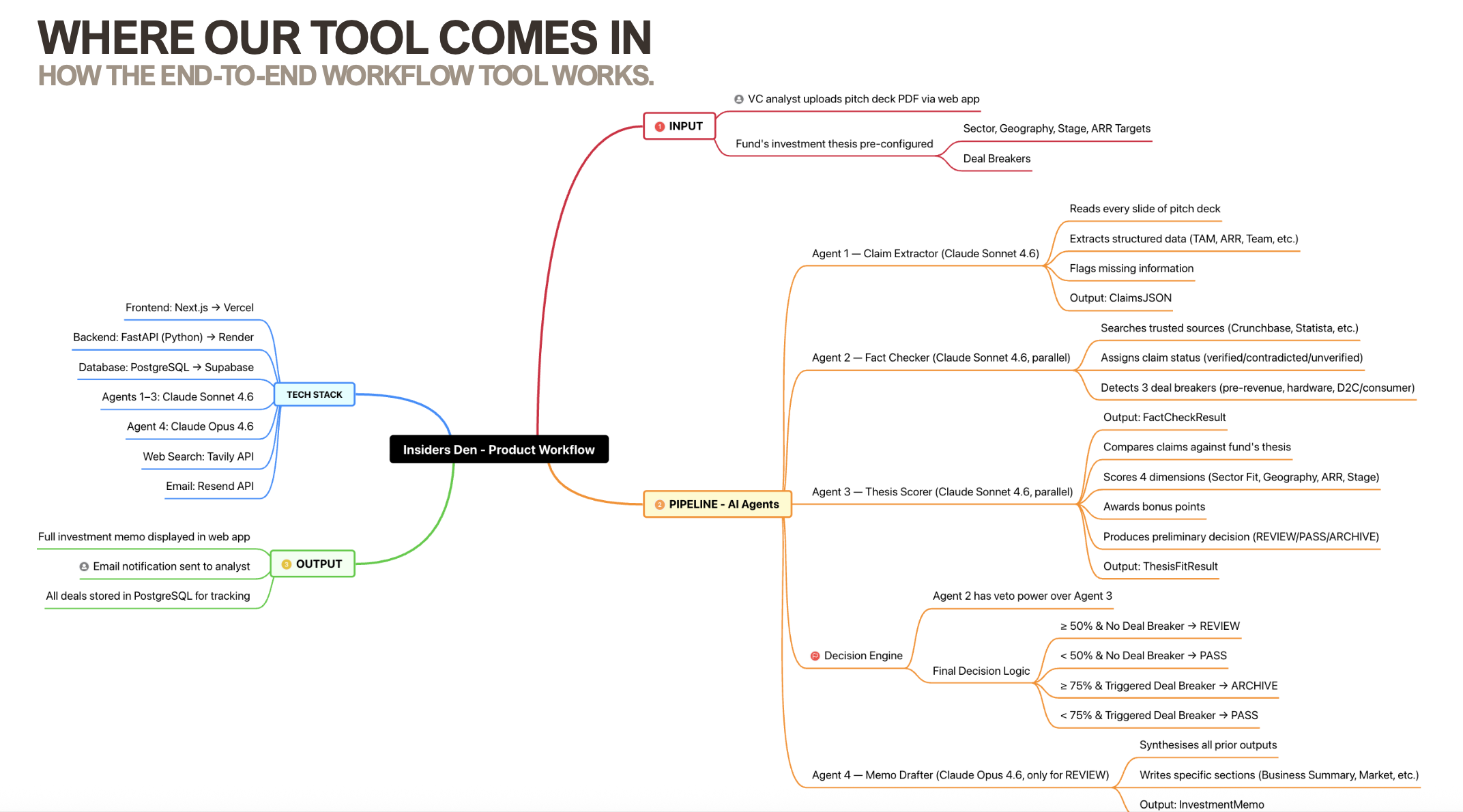
Insider's Den lets a VC analyst upload a pitch deck PDF. Four specialised AI agents then work in sequence (and in parallel where possible) to extract claims, fact-check them, score thesis fit, and — only for promising deals — draft a full investment memo.
← Here's what we actually built
Claim Extractor
Reads every slide. Extracts structured data — TAM, ARR, team background, geography. Flags missing fields. Outputs a ClaimsJSON object.
Fact Checker
Searches domain-whitelisted sources (Crunchbase, Statista). Assigns each claim a status: verified / contradicted / unverified / not_found. Detects deal breakers.
Thesis Scorer
Scores 4 dimensions against the fund's pre-configured thesis: Sector, Geography, Stage, ARR. Produces a preliminary decision: REVIEW / PASS / ARCHIVE.
Memo Drafter — REVIEW only
Only fires for deals marked REVIEW. Synthesises all prior outputs and writes a full investment memo: Business Summary, Market, Team, Risks, Recommendation.
03 — Tech Stack
Built to be reliable, not just impressive
We chose tools for correctness and reproducibility — not hype. Every agent runs at temperature=0 with file-hash deduplication so the same deck always produces the same result.
04 — Technical Challenges
Where the hard decisions were made
The most interesting product work happened in the tradeoffs — between accuracy and speed, determinism and flexibility, automation and human oversight.
Image-heavy PDFs
Many pitch decks are built in Figma or Canva and exported as pure images. Standard text extraction returns empty strings, causing Agent 1 to miss critical data.
→ Two-pass PDF parser: text first, vision API fallback for slides under 50 charactersFact-check noise
Open web search returns opinion-heavy or irrelevant sources that could falsely contradict legitimate startup claims.
→ Tavily domain-whitelisted to trusted sources + 4-level status systemParallel agent coordination
Agents 2 and 3 run in parallel to cut latency. But Agent 3's final action should be overridden by Agent 2's deal-breaker flags — a sequencing problem in concurrent execution.
→ Agent 3 runs with empty placeholder; post-processing decision engine applies A2 vetoLLM non-determinism
Probabilistic sampling means the same deck uploaded twice produces different scores — unusable for a tool investors need to trust.
→ temperature=0 on all agents + file-hash deduplication skips re-runs entirely05 — What's Next
Roadmap beyond the MVP
The MVP solves the initial screening bottleneck. The roadmap extends the tool into a full deal lifecycle platform.
See it in action
Upload a pitch deck and watch the agent pipeline run — from raw PDF to structured investment memo in under 2 minutes.